
Delaware County City Directory Collections by Community
Delaware County has 49 municipalities, so the historical shelf is a set of local runs rather than one uninterrupted county title. The Delaware County Historical Society lists physical runs for Chester City, Aston Township, Eddystone, Media, Upland, and several other communities. Its list is a holding guide, not proof that every year in an apparent span survives or is digitized. Choose a title for the municipality and year in question, then inspect the title page and the pages around the entry.
| Collection | Years represented | Where held | Access route |
|---|---|---|---|
| Chester historical volumes | 1879-1931; 1941, 1956, 1959 | Delaware County Historical Society holdings | Consult the title-specific physical holding |
| Media directories | 1883-1886; 1891; 1906; 1917-1931; 1941 | Delaware County Historical Society holdings | Confirm the individual volume before use |
| Aston and Eddystone runs | Aston 1951-1994; Eddystone 1889-1898, 1901-1912, 1917-1931, 1941, 1956 | Delaware County Historical Society holdings | Community and year selection required |
| Library digital directory and census resources | Varies by title and search result | Delaware County Libraries | Use Ancestry Library Edition on a library computer |
| Telephone books | 1957, 1958, 1965, 1970-present | Delaware County Historical Society holdings | Use as dated listing evidence |
Other named holdings include Upland, West Chester, and a 1914 Delaware County Farm & Business Directory, plus a 1936 Philadelphia title. The Historical Society also lists some pooled 1941, 1956, and 1959 entries for smaller communities. Its Marcus Hook line includes an ambiguous first year, so ask the repository to verify that title before recording a date.
Note: A directory run is evidence for a particular publication year, not a complete roll of every person connected to that place.
Chester’s 1859 Directory Clues
The clearest early title in the research is E. F. James’s Directory of the Borough of Chester for 1859-60, published in 1859 and catalogued at 128 pages. Its catalogue description says the volume arranged inhabitants alphabetically and included occupations, places of business, and dwelling houses. It also covered streets, schools, churches, travel lines, societies, and business or professional cards. Those fields belong to this specific title, not automatically to a later Delaware County directory.
The catalogue record for the 1859-60 Chester directory preserves the title and publisher context for this early example.
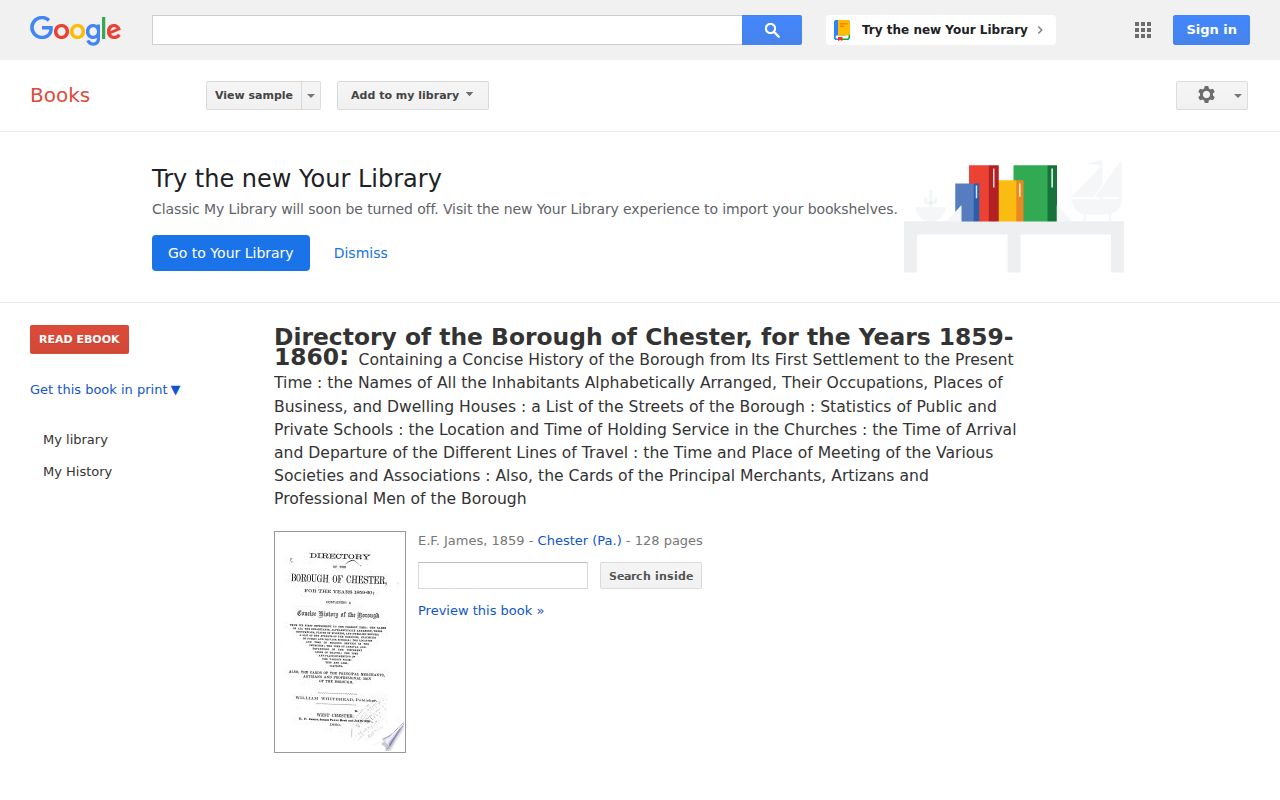
That catalogue image is a sound starting point for the volume, but the original listing still supplies the exact printed spelling, page, and any abbreviation used for a person or address.
Title-page rule. Keep the exact title, year, page, and abbreviation key with every Delaware County directory entry note. A later title may use different fields or a different community boundary.
Delaware County Historical Library Routes
Delaware County Libraries provide a public route to digitized historical material. Their Digital Library lists Ancestry Library Edition, which can be used on a library computer without a library-card barcode. County Planning’s historical-research guidance specifically recommends an address-led directory search: leave the name fields blank, enter “Delaware County, Pennsylvania, USA” in the lived-in field, put the house number and street in Keyword, and add a residence year when one is known.
That method can find a historical listing when a name is unknown, but it does not promise that a given street was indexed in every title. The same guidance identifies HeritageQuest, Google Books, Internet Archive, and Temple University’s Philadelphia directory guide as possible collection paths, with access varying by source. A library workstation remains the practical route when a subscription title is not available at home.
The Delaware County Libraries Digital Library shows the genealogy and historic-newspaper resources available through the county library system.
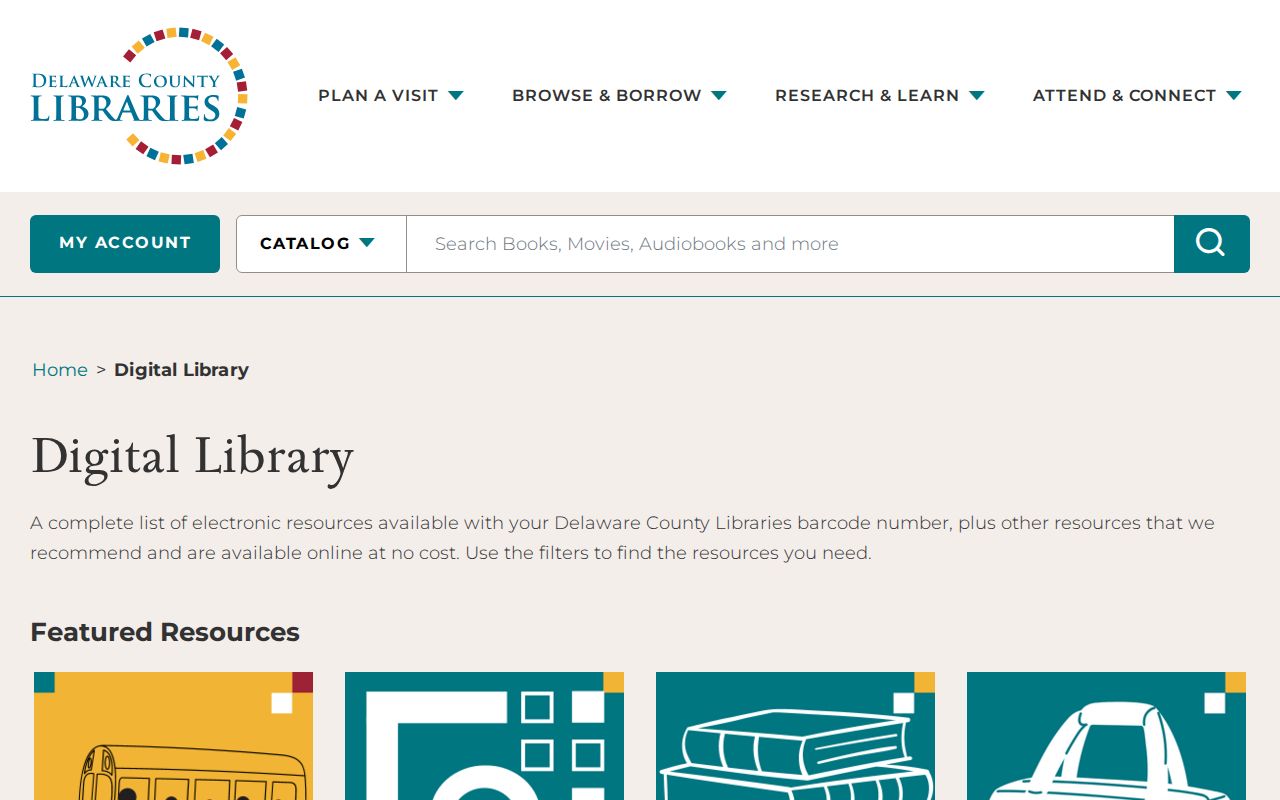
The library route adds both historical-listing searches and census material, which makes it useful for testing a dated entry rather than relying on a single index hit.
Reading Delaware County Historical Directory Entries
A historical listing should be transcribed as printed, then interpreted cautiously. No person-specific page was opened in the research, so no invented sample line belongs here. The verified Chester title supports several possible fields, while County Planning confirms that a digital directory result can be tied to a residence year and found with an address keyword. Check the printed page to learn whether a name is a residence, a business, or another type of entry.
| Printed name | Record initials, spelling, suffixes, and variants exactly as the volume gives them. |
|---|---|
| Residence year | Use the directory’s stated year or publication date as the time marker. |
| Address clue | Preserve the house number, street spelling, and municipality exactly as printed. |
| Occupation or business | Record it only when the specific entry prints it, as the 1859-60 Chester title can. |
| Title and page | Keep the collection title, page or image, and the original abbreviation key together. |
- Criss-cross directory
- A directory arranged by street and number, used to locate a listed adult or telephone subscriber from an address.
- Householder index
- An index organized around the named household contact, not a guarantee that every person at an address appears.
- Abbreviation key
- The volume’s own guide to shortened terms. Read it before expanding a notation in a research note.
Directory conventions vary across publishers and decades. Do not add a spouse, a relationship, a possession status, or a business-residence distinction unless that individual title actually prints it.
Newspapers Between Delaware County Directory Years
Local newspapers can bridge a gap between directory editions. Delaware County Libraries list the Chester Daily Times for 1876-1881, the Chester Evening Times for 1886, the Chester Times for 1882-1959, and the Delaware County Daily Times for 1959-1994. Their newer NewsBank access includes text from 1994 forward and image editions from 2023 forward. Notices can help test an address, a community connection, an obituary, or an older street form.
The Historical Society adds the Rockdale Herald, bound Morton Chronicle volumes with gaps, an 1819-1870 newspaper compilation, and extracted death and marriage notices. Church registers and local historical files can add a parish or family lead. They remain historical sources, so each result needs its publication date, title, page, and image checked against the original.
Trace Families Through Delaware County Directory Volumes
Family history becomes more reliable when a directory year is paired with nearby census and record evidence. Released federal census schedules reach 1940, and the 1890 population schedule is absent. A census image can show a household and adjacent enumerated households at its date. A printed volume can supply an annual or near-annual address and occupation clue between census years. Neither source proves a present connection.
- Start with one known name, address, municipality, or year and preserve the source details already in hand.
- Search a directory by surname variants and initials, or use the verified address-keyword method when the street is known.
- Record the title, year, page, address spelling, and any original abbreviation before moving to another volume.
- Compare the closest released census image, then test the street and lot against an atlas or Sanborn map.
- Use a dated obituary, estate index, cemetery or veteran-grave record to investigate a later endpoint through its custodian.
A disappearance may reflect a move, changed directory coverage, an unlisted household, a name variant, death, or an altered street number. It is not a conclusion by itself. For an address-based backward trail, use the Delaware County previous residents route to pair the dated listing with parcel and deed evidence.
Note: Compare sources that are close in date, because a directory listing and a census page can describe different points in the same household’s history.
Delaware County Directory Gaps and Archives
When a printed directory volume is missing, the Delaware County Archives offers a different set of historical indexes. Its administrative holdings mostly span 1789-1950 and include assessments, administrations, naturalizations, historic court material, wills, veteran-grave registrations, and County Home records. The Archives does not control Recorder of Deeds material, so a deed question still belongs with the Recorder. Its online indexes are finding aids, while counter and mail routes support original-material checks.
The Delaware County Archives index and access page explains the historical-record collections and its in-person or mail copy procedures.
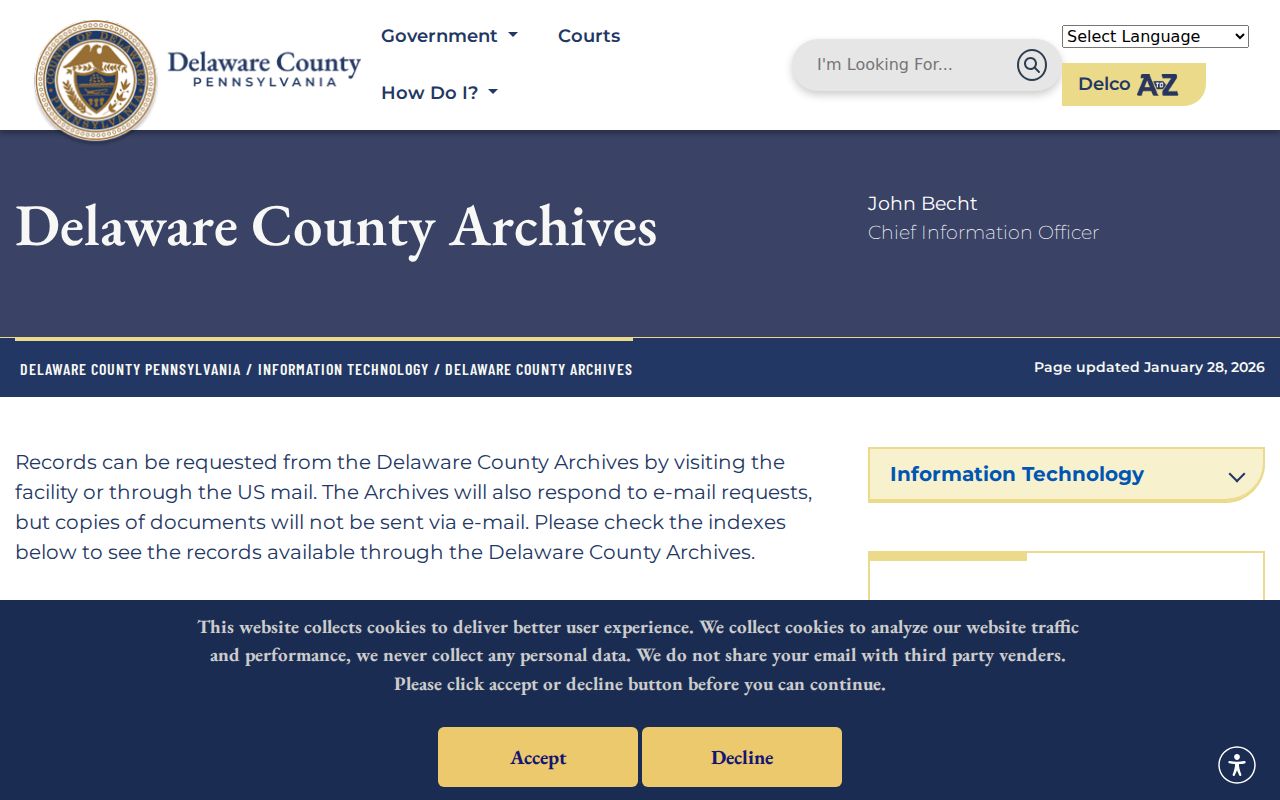
The Archives is especially useful where a directory leaves a gap, but the record series, date range, and stated gaps must remain part of the citation.
Delaware County separated from Chester County in 1789. Early material can therefore appear under Chester County, and the County Home index uses “eloped” to mean a person ran away from the Home, not that they married. Both details prevent an easy but inaccurate historical reading.
Delaware County Directory Places on Maps
Maps help decide whether the address in a directory is the same place shown in another source. County historical-map holdings include 1870 and 1875 atlases, an 1882 railroad atlas, 1902 Baist, 1909 and 1913 Mueller atlases, 1920s Sanborn material with additions, and later 1934, 1942, 1947, and 1961 mapping. Chester Sanborn volumes cover 1965-1985. The Library of Congress also documents a 1919-1925 county compilation with 114 sheets.
A map can support a street, lot, building footprint, or neighborhood-context check. It does not name every person at a place. Compare the map’s date and label with the directory’s municipality, then treat a changed street spelling or boundary as a research question rather than forcing the modern address backward.
County Planning’s historic-research resources also point to the Historical Society, County Archives, Free Library of Philadelphia, Greater Philadelphia GeoHistory Network, PHMC, and Penn State Sanborn material. The County historic-research gateway is useful for selecting the institution that holds the original map, newspaper, or local collection. Preserve the map title, sheet or page, scale where stated, and the date viewed. Those details make a later address comparison reproducible.